0
0
Donaciones & Pagos
No hay nada en el carritoIr al Inicio

Support for Educational Inclusion

This program is aimed at children and young people with Down syndrome, aged between 5 and 20, and its objective is to support their process of educational inclusion in regular kindergartens and schools.

About our Educational Inclusion Support Program

Its objective is to accompany their process of educational inclusion in regular kindergartens and schools, providing specific knowledge about the condition and supporting teachers in making adjustments, adjustments, and methodologies to be taken into account in their teaching process.

Working together with teachers to ensure that students can develop their academic, emotional, and social skills to the fullest, enabling them to interact assertively and appropriately throughout their lives.

It includes support for both the family and the school environment and is provided by the Educational Support Professional (PAE).

How do we do it?

Supporting families in their search for a school
  • Preparation for school search: Workshops aimed at families in EARLY CHILDHOOD programs who are entering the IAR program, providing up-to-date information on the school inclusion process that allows families to have clear criteria when searching for and choosing a school for their child.
  • Support is provided to two institutions previously selected by the families, in accordance with their expectations. 
  • The School Support professional gives their technical opinion verbally and/or in writing, and the family makes the decision they consider most appropriate.
Types of educational support services
  • This service includes 21 three-hour sessions per year from February to December, which will be held at school and some at home during vacation periods to help children and young people have an educational plan that maintains the achievements they have been working on during the school year.

If the family wants more accompaniments, and if the school agrees, the CSD can increase this to 39 accompaniments per year.

Educational support at school

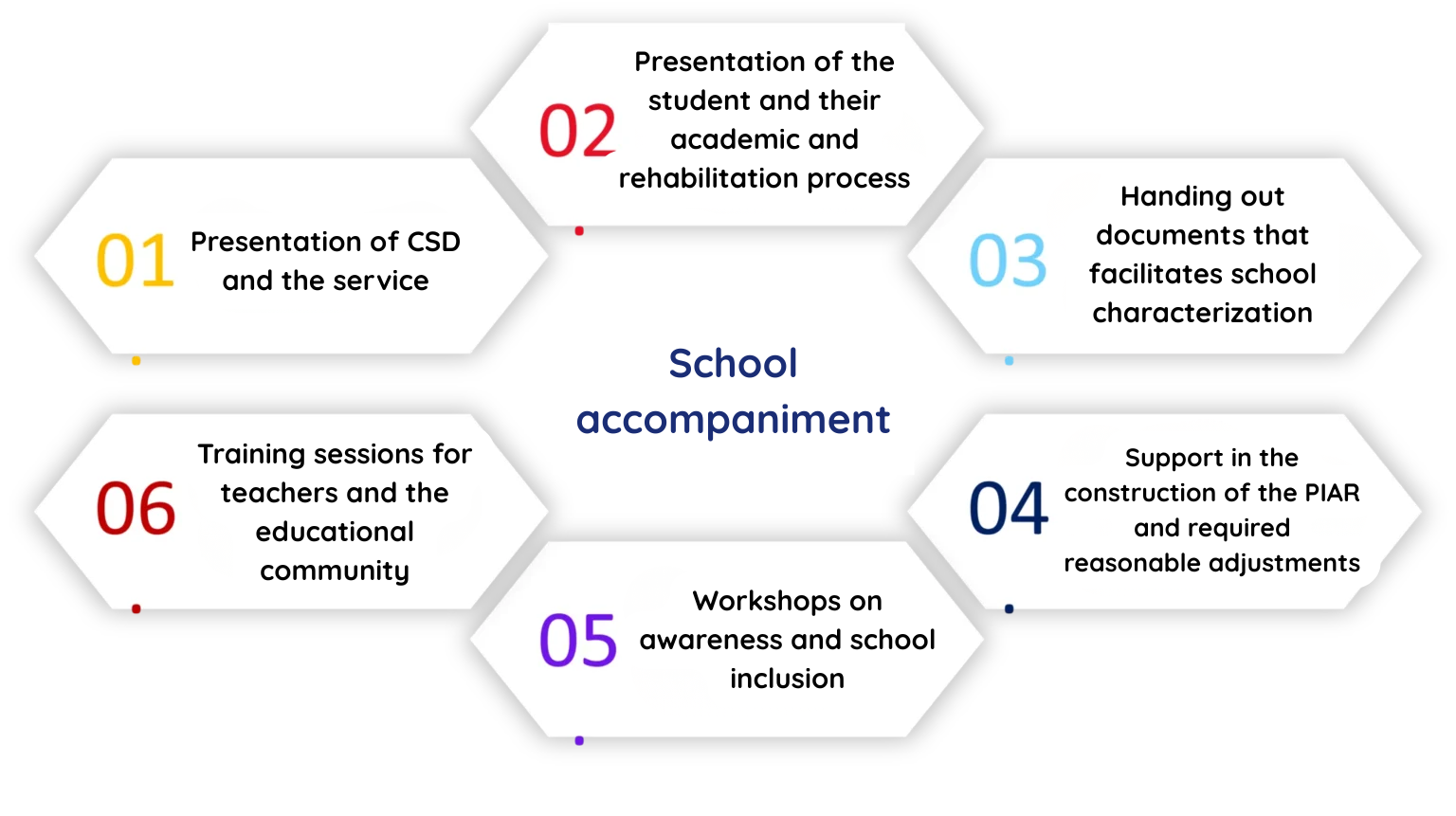
Introduction to CSD and the service.

The assigned professional, the program coordinator, and the family explain the dynamics of the service to school administrators and teachers, how the process is supported collectively, and how we all become guarantors of inclusion.


Introducing the student and their academic journey

Introduction of the student and their family, sharing the therapeutic and academic intervention report, tools that will facilitate educational planning.

Handing out documents

  • FR100 – curriculum competency level delivered
  • FR 189 – Visit and follow-up records  
  • FR 51 – Report on social skills in a school context

Planning and construction support for the PIAR.

  • Assistance in selecting indicators for different subjects and in determining how our students should participate based on the topics covered.
  • Important criteria regarding the reasonable accommodations required are discussed and agreed upon.
  • Guides and flexible working models are provided for basic subjects.
  • Methodologies and strategies are modeled to facilitate learning.

Awareness and welcoming workshops

Workshops for peers addressing issues such as welcoming new students, how to support them appropriately, and clarifying different questions about school coexistence and respect for differences.

Teacher training

  • Training for teachers on various topics related to disability and inclusion
  • Monitoring of the process with the group's lead teacher and/or teachers from different areas, exchange of knowledge and strategies.
Educational support at home
  • Teach the family or person in charge intervention strategies for social and academic skills.
  • Address specific situations regarding access to digital information, using platforms and virtual pages that contribute to the educational process.
  • Co-creation of support systems in routines that build the habits necessary to strengthen autonomy and independence.
  • Guidance for ninth, tenth, and eleventh grade students on the use of required formats for Saber tests

A picture is worth a thousand words...